Zima Blue, Artificial Intelligence, and the Value of Coming Home
By Angrafista
Zima Blue, Artificial Intelligence, and the Value of Coming Home
A few days ago, I sat down in front of Netflix and rewatched an episode I had completely forgotten about. It lasts just a few minutes.
However, seven years after its premiere, it remains one of the most interesting reflections I’ve seen on creativity, technology, and purpose.
Zima Blue.
It’s part of the first volume of Love, Death & Robots and tells the story of Zima, a legendary artist known for his monumental cosmic works and for a mysterious shade of blue that appears repeatedly in each of them.
As the story unfolds, we discover that Zima isn’t exactly who everyone thinks he is.
And that’s where the episode stops being about science fiction and starts being about us.
The obsession with doing more
Zima’s career is a constant climb.
First he creates portraits.
Then landscapes.
After that, murals.
Later, he takes over entire buildings.
Finally, he modifies planets and celestial bodies.
Each new work is bigger.
More ambitious.
More complex.
More impressive.
But also further from what he’s really looking for.
While watching the episode, I couldn’t help but think about artificial intelligence.
In recent years, we’ve witnessed an unprecedented technological explosion.
Today we can generate images in seconds.
Create entire videos from text.
Design interfaces.
Write articles.
Animate characters.
Develop entire visual concepts with tools that just a few years ago seemed impossible.
Execution has accelerated.
Production has become cheaper.
Technical capability has been democratized.
And yet, the question remains the same:
What do we do with all of that now?
AI has made execution more affordable
For a long time, a significant part of a designer’s value was tied to their ability to execute.
Mastering tools.
Learning processes.
Solving complex technical problems.
But when a tool can produce hundreds of images in a matter of seconds, value begins to shift elsewhere.
Because execution is no longer scarce.
Identity is.
Technique is no longer exclusive.
Judgment is.
Production is no longer a barrier.
Creative direction is.
That’s why the current conversation about artificial intelligence rarely ends up talking about technology.
It ends up talking about meaning.
The blue square
There’s a fascinating detail in the episode.
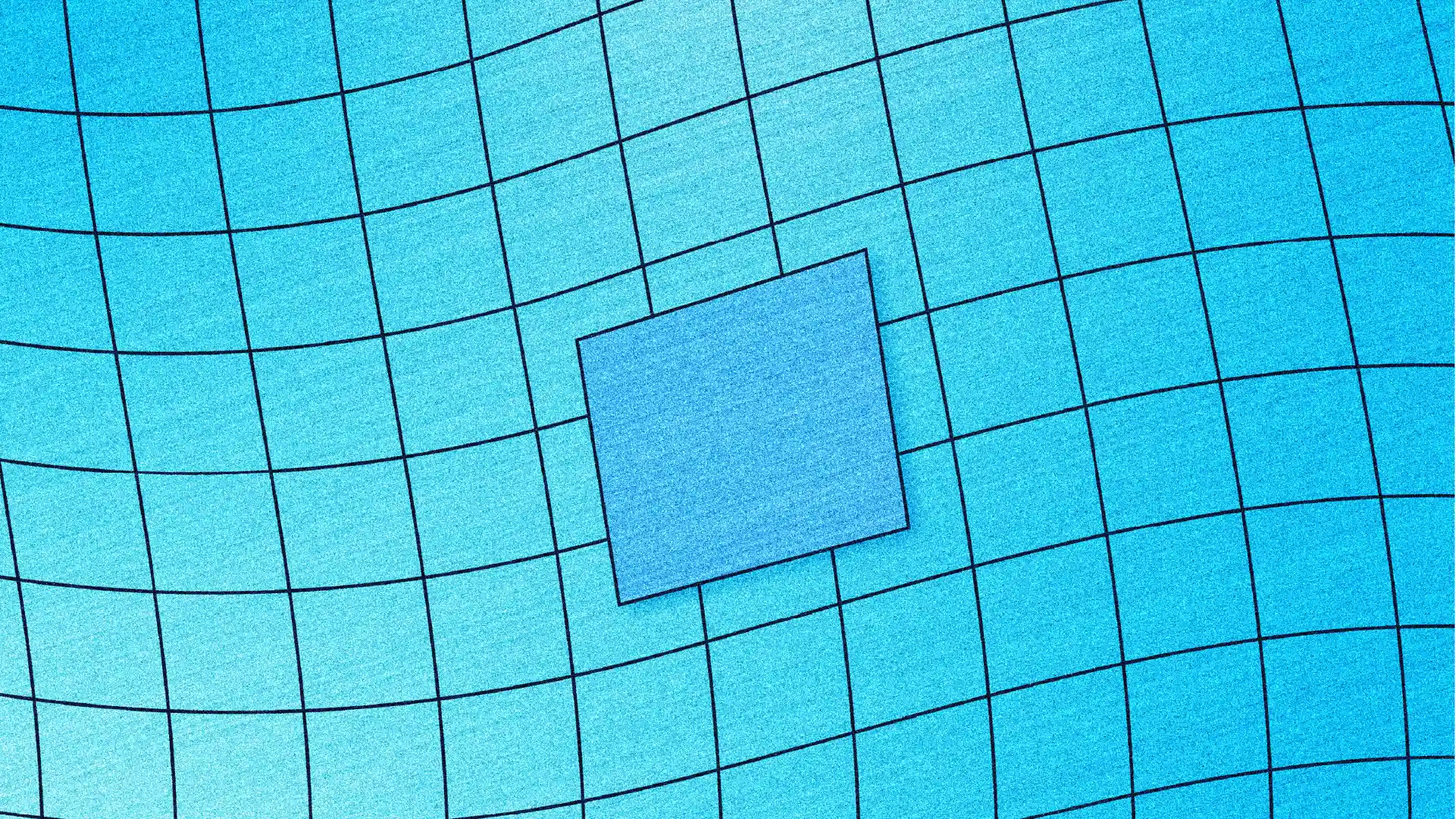
Throughout his career, Zima incorporates a small blue square into his work. At first, it seems insignificant.
A minor detail inside enormous compositions.
An almost imperceptible mark next to murals the size of buildings, planets reshaped into art, cosmic landscapes that stretch across galaxies.
But that small blue square never disappears.
It is always there.
Quiet.
Constant.
Slightly out of place.
And as Zima’s work grows more ambitious, that tile becomes the only element that stays the same.
The only fixed point in a body of work that keeps expanding outward.
At first it reads as a signature.
Then as an obsession.
Then as a clue.
Because everything that truly matters in his story is hidden inside that small, persistent blue square.
The return of texture
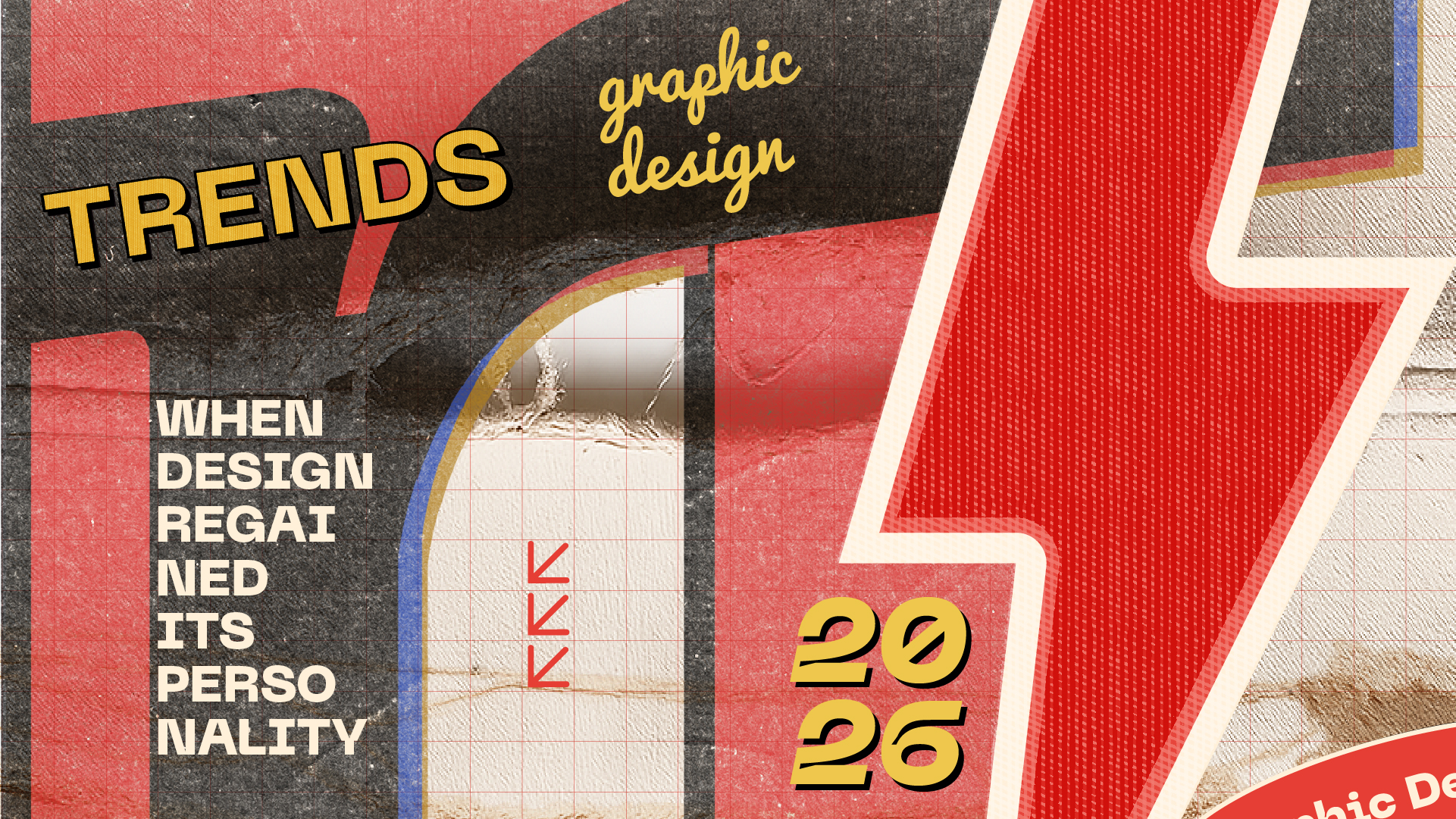
Something interesting is happening in contemporary design. Just as our tools have become capable of producing technically perfect images, designers are beginning to embrace imperfection.
Textures.
Noise.
Grain.
Collage.
Expressive typography.
Editorial composition.
Seemingly unfinished elements.
We see it in branding.
We see it in graphic design.
We see it in motion graphics.
We see it in advertising.
At first glance, it seems like an aesthetic issue.
But I think it’s something deeper.
It’s a reaction.
Because when everything can look perfect, perfection ceases to surprise us.
Texture once again conveys a human presence.
Mistakes once again convey authorship.
Imperfection once again conveys identity.
As if design were trying to reclaim something that automation cannot produce on its own.
The Designer and the Pool-Cleaning Robot
The big revelation of the episode is that Zima was never a man.
Nor a space explorer.
Nor a cosmic artist.
Originally, it was a robot designed to clean a swimming pool.
Nothing more.
Its entire technological evolution had taken it further and further from that starting point.
Until it finally understands something.
It wasn’t seeking to advance.
It was seeking to understand.
That’s why its final work isn’t about building something bigger.
It’s about returning.
Returning to the pool.
Returning to the blue.
Back to the origin.
Back home.
Perhaps that is also our question
Artificial intelligence is transforming the creative industry.
That is no longer up for debate.
It will change processes.
It will reduce time.
It will automate tasks.
It will generate new opportunities.
And also new challenges.
But perhaps the most interesting question is not what AI can do.
Perhaps the question is what remains uniquely human.
Because if value lay solely in producing images, the discussion would likely already be over.
However, we continue to value ideas.
We continue to value stories.
We continue to value brands with personality.
We continue to value what conveys intention.
Like Zima, perhaps the creative sector is undergoing its own quest.
A quest that began with increasingly sophisticated tools and now seems to be leading us back to much more essential concepts.
Identity.
Authorship.
Meaning.
Purpose.
Perhaps artificial intelligence isn’t forcing us to create more.
Perhaps it’s forcing us to remember why we started creating in the first place.
And perhaps that is our own blue tile.